Why FLSmidth came to us
FLSmidth approached Centre of Business to optimise costs in their supply chain. The initial exploration focused on automating their purchasing activity, an area where a high volume of transactional work was being handled manually by people whose time was better spent elsewhere.
Our first meeting with FLSmidth management was not a pitch. It was a working session to understand the requirements properly, review the current people, process and technology involved, and explore related opportunities that sat adjacent to the original brief. That last part matters: the problem a business names first is rarely the whole opportunity, and scoping only to the stated symptom leaves value on the table.
What we put in scope
Out of that review we set the focus on automating transactional supply activity. Specifically:
- Purchase order life-cycle management, covering all facets of the cycle rather than a single step within it.
- Inter-branch transfers, moving stock between locations without manual re-keying.
- Stock redistribution of excess stock, so surplus in one branch could serve demand in another instead of sitting idle.
Each of these shares the same profile: high volume, rules-based, repeated many times a day, and entirely dependent on a person remembering to do it correctly. That is exactly the work automation should absorb, and exactly the work where manual handling quietly costs the most.
What we built
Everything in scope was delivered under budget. The build ran from the scripts themselves through to how the results were surfaced to management:
- Building and scheduling the scripts that generate and automate the transactional activity.
- Presentation of insights, results and trends on business intelligence dashboards.
- Complete integration with their ERP, so the automation operated inside their existing system of record rather than alongside it.
That last point is the one most often skipped. Automation that runs beside the ERP creates a second version of the truth and a new reconciliation job. Automation that runs inside it removes work without adding any.
The result
Three months after go-live, the results had exceeded the business case estimates.
10:1return on investment on the purchase order component alone, breaking even in only five weeks.
Worth reading that precisely. The 10:1 is on the purchase order component alone, not the project as a whole, and the payback period was five weeks rather than the multi-year horizon typical of transformation programmes. The remaining components of the build sit on top of that figure.
The secondary benefits
The direct saving was the headline, but it was not the whole return. Automating the transactional layer produced several second-order effects:
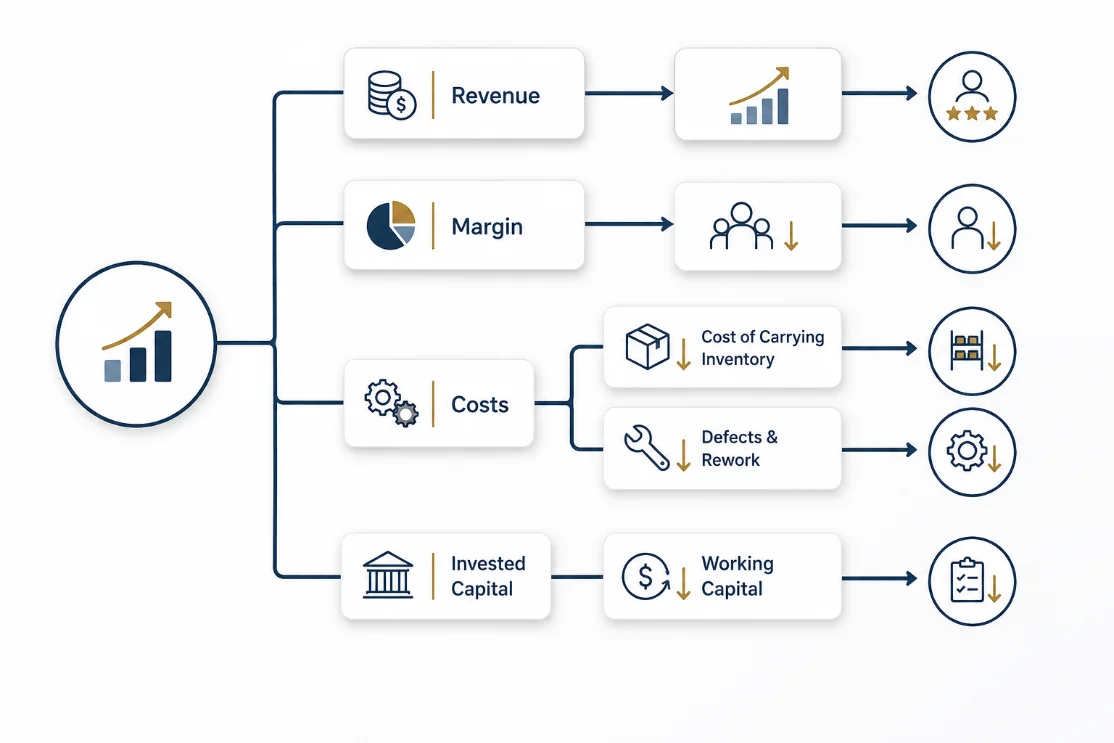
- Working capital improvement through reduced excess stock.
- Lower cost of carrying inventory, following directly from the above.
- Reduced defects and rework, because automated transactions do not make the errors manual re-keying does.
- Guaranteed adherence to policy, since the rules are executed by the system every time rather than applied at a person's discretion under time pressure.
By extension, this should lead to improved order-to-execution cycle times and increased revenue. The policy adherence point is the one clients tend to underrate. Most organisations have sound purchasing policy already; what they lack is a guarantee it is followed on a busy Friday afternoon. Automation converts policy from an intention into a property of the system.
What transfers to other operations
The specifics of this build were FLSmidth's, but the pattern is not unusual. Most manufacturers and distributors carry a substantial volume of transactional supply activity that is rules-based, repetitive and handled manually, and in most cases it has never been measured as a cost because it is spread thinly across several people's days.
If that describes your operation, the first question is not which tool to buy. It is how much of that activity exists, what it currently costs, and which portion of it is genuinely rules-based. That is what an operational review establishes, and it is where this engagement started.