Min/max settings were built for an average week. Christmas is not one.
The eight weeks before Christmas can be anything but average. Levels calculated from last year's usage will be wrong on both sides of the peak.
The eight weeks before Christmas can be anything but average. Levels calculated from last year's usage will be wrong on both sides of the peak.
Min/max is a simple rule. When stock falls to the min, order back up to the max. It works well whilst demand is steady and lead times are reliable.
The trouble is the inputs. Most min and max levels are calculated from average usage over the last six or twelve months. A promotion, a seasonal peak or a new retailer listing breaks that average in two ways.
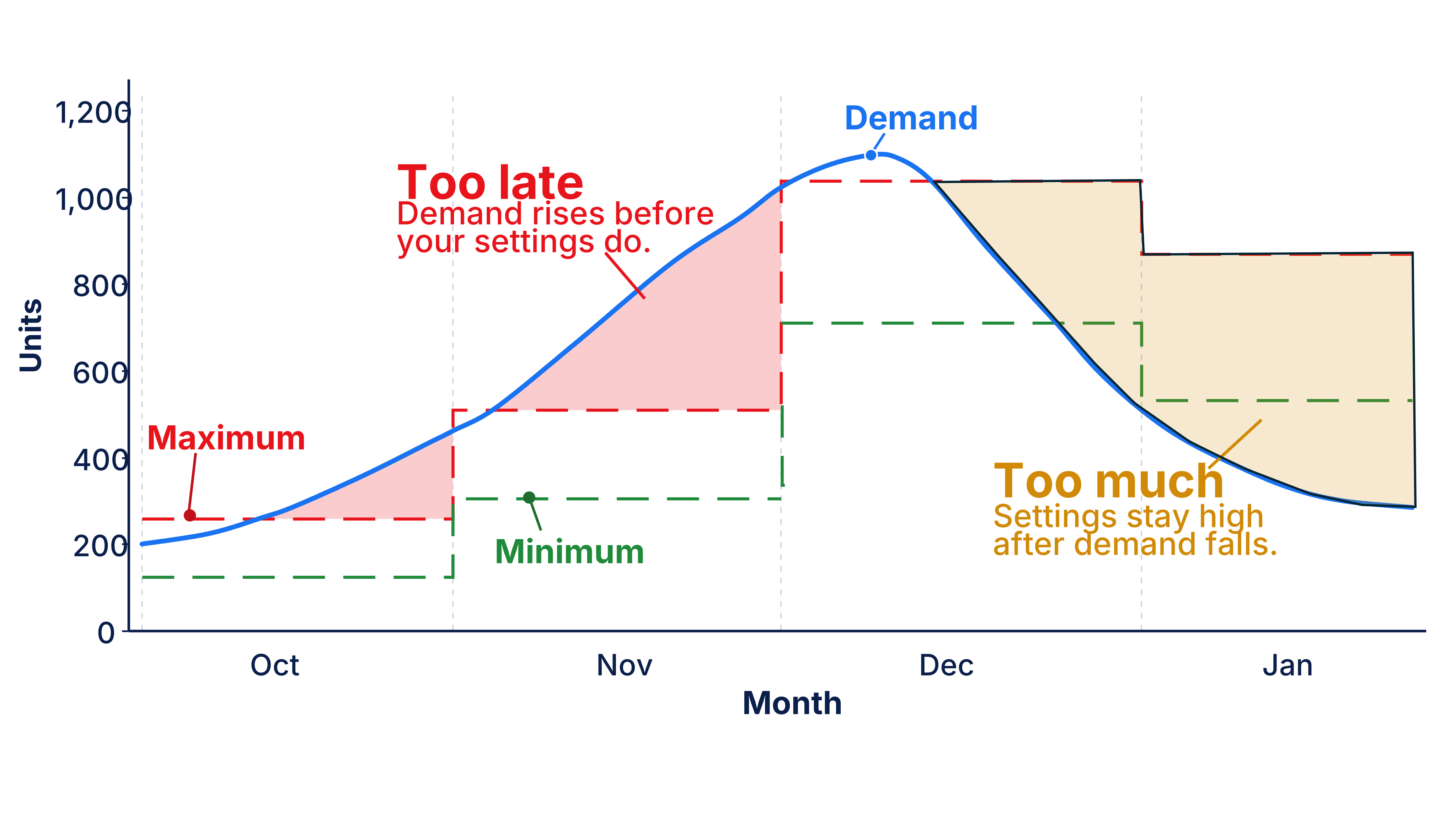
The answer is not to throw out min/max, but rather to stop treating the levels as fixed. Separate base demand from promotional and seasonal uplift, then set levels from forward demand rather than history.
Every extra week of cover on a seasonal stock code is cash sitting in the warehouse. With some raw materials sharply higher in cost this year, that cash is worth more than usual.
The takeaway is to ensure that your min/max settings are reviewed regularly. Depending on your business that could be monthly, quarterly, or maybe only when something goes wrong.
Most min and max levels are calculated from average usage over the last six or twelve months. A promotion, a seasonal peak or a new retailer listing breaks that average. Before the peak the min is too low, so orders trigger too late and the line runs short. After the peak the max is too high, so the rule keeps topping up stock the market no longer needs.
Don't throw out min/max. Stop treating the levels as fixed. Separate base demand from promotional and seasonal uplift, then set the levels from forward demand rather than history, and reset them once the peak has passed.
Book a consultation and we'll look at how your min and max are calculated, and where seasonal demand is breaking them.